Basic Information
Description
Description of the Rhythms Series:
The RHYTHMS series consists of vector graphics created using mathematical formulas to define shapes, lines, and colors. The works are composed of paths—lines, curves, and shapes— executed through specific commands and defined by points, coordinates, and curves. This structure allows the images to be scaled up or down without any loss of quality or pixelation.
In 1982, Rogala first gained access to a Hewlett-Packard computer at an architectural office in Chicago. He experimentally selected drawing modes from the command menu and then made gestures with a handheld device, specifying repetitions and variations of free-form shapes. These gestures explore the balance between order and chaos, intentionally introducing random “disorder” into the compositions to metaphorically represent Chicago’s towers, landscapes, and vitality.
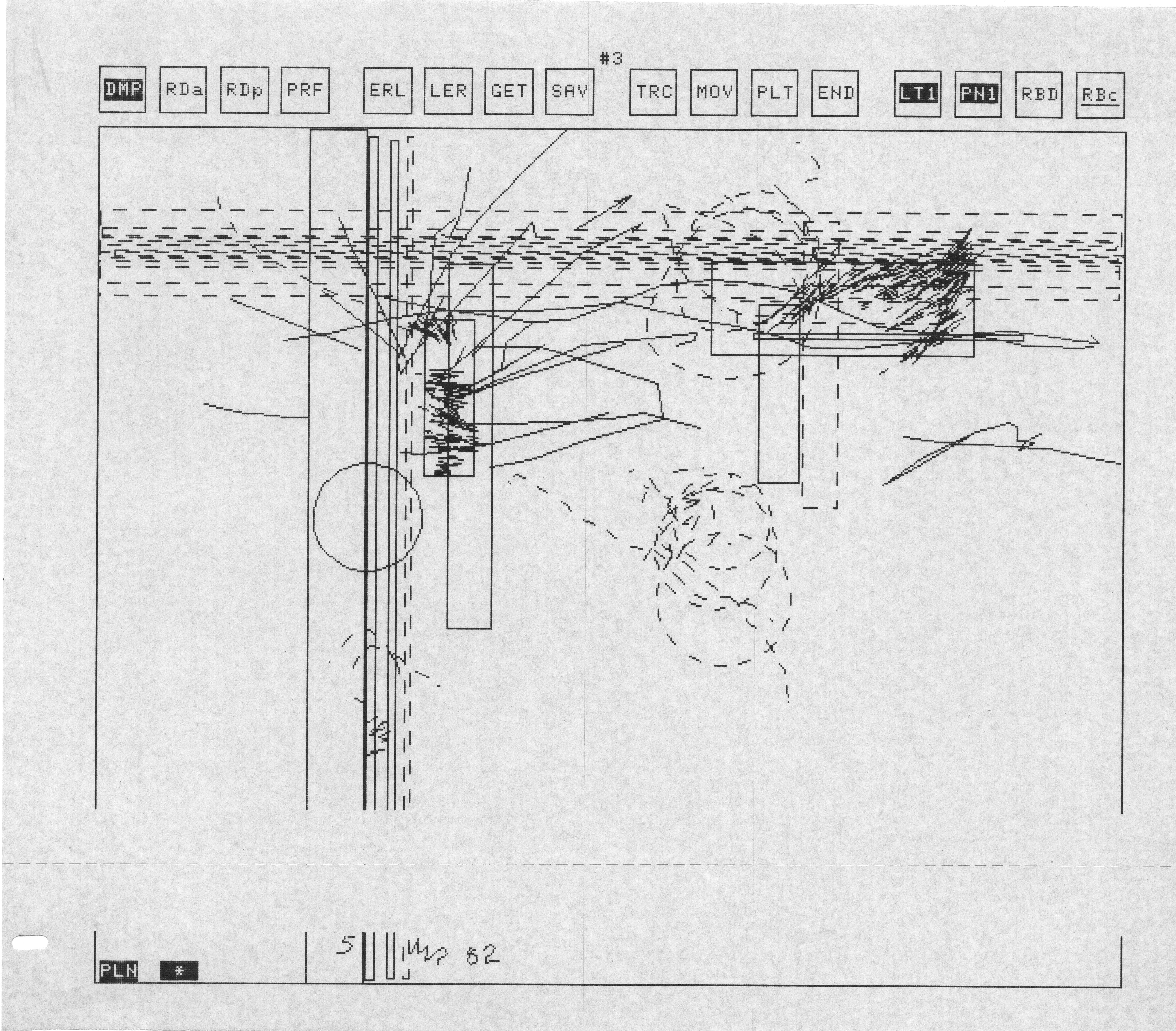
The black highlighted command-menu boxes at the top of each plotter drawing indicate the active commands in use by the plotter, a feature typical of early software interfaces.
Description of Rhythms: Interrupted-4:
This 1982 plotter drawing offers a rare glimpse into the formative years of computer-assisted graphics. Unlike works generated through algorithmic languages such as FORTRAN, this piece was created manually using a command menu application of HP-GL (Hewlett-Packard Graphics Language), making it a fundamentally analog process of human– machine interaction. Whereas artists working with FORTRAN would establish algorithmic rules but could not fully control the visual outcome, here the artist directed and shaped the drawing from start to finish through explicit command inputs.
The work is drawn on thermal paper — a now obsolete, fragile, and highly unstable medium once common in early computer output. Its rarity today adds to the historical and archival significance of the piece, as very few examples on this medium have survived in good condition. The composition combines geometric precision with layered visual complexity: rectangles, circles, and flowing lines — some solid, others dashed — intersect and overlap, suggesting multiple layers, trajectories, and data points. At the top of the sheet, a command menu is visible, displaying abbreviated plotting functions such as “LT1” (line type), “PN1” (pen number), and “DMP” (dump, meaning the plotter is switched on), alongside familiar codes like “SAV” (save), “PLT” (plot), and “MOV” (move). These terse commands reveal the operational language through which the artist directed the machine, step by step. Rather than relying on preprogrammed algorithms, the drawing was executed through direct human selection and command input, which were then translated into vector instructions by the plotter. This “interrupted” image underscores the dialogue between human decision-making and mechanical execution, offering a glimpse into the technical syntax that underpinned early creative experiments with computers. It stands both as a historical document of digital culture and as an emblem of the experimental frontier at the dawn of generative art.